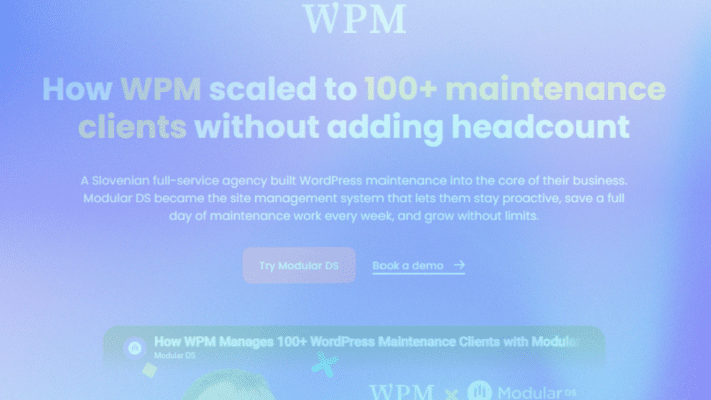
Modular DS has published a case study about WPM. It tells the story of how we grew past 100 maintenance clients without growing the team, and what changed after we moved our entire portfolio to a new site management system. We’re proud to be among the first agencies featured in their case studies, and the first one from Slovenia.
You can read the full story on the Modular DS website. Here’s our own take on it, including the part that matters most to our clients.
Why We Changed Tools in the First Place
For years we managed client websites through ManageWP. It worked, until it didn’t scale with us. As the portfolio grew, getting a clear picture of every site’s status took longer than it should have. Performance was inconsistent, the interface felt dated, and we spent time hunting for information instead of acting on it.
At 100+ websites, that kind of friction adds up fast. “I didn’t have time to wait or search through notifications. I need to trust the tool, and I didn’t trust it anymore,” says Jurij Oblak, our CEO.
We knew we needed something better. What held us back was the obvious problem: migrating a portfolio that size is the project you never quite have time for. Then we met the Modular DS team at WordCamp Europe 2025 in Basel, and the timing finally made sense.
The migration itself turned out to be the easy part. We shared access to our ManageWP account and Modular DS handled the rest in the background. No manual moving of sites, no setup weekends.
What Actually Changed
The biggest difference was transparency. Having a clear, real-time overview of every website we manage makes the whole process easier to control. Less time chasing information, more time on work that helps clients.
Day to day, our team leans on automatic updates, backups, health and security notifications, and one-click login to any site. Where this shows most clearly is security. We get alerted to risks as they appear, which means we can act before they turn into actual problems. When something like the recent critical WordPress 7.0.2 vulnerability lands, the difference between seeing it immediately and finding out later is the whole ballgame.
For our clients, this mostly looks like nothing happening. Fewer disruptions, fewer emergencies, fewer of those emails that start with “our site is down.” That quiet reliability is a big part of why our churn stays below 1%.
The Numbers From 2025
The case study pulled together figures we don’t often put in one place:
- 118 websites managed through Modular DS
- 8 hours saved per week on maintenance tasks, a full working day
- 25 new maintenance clients added in 2025, with the same core team of 13
- 28 websites delivered and 17 new partnerships in the same year
- 100% completion rate across 7,653 support tickets
- 25% revenue growth year over year
The point isn’t any single number. It’s that we could take on more clients and more scope without expanding the team proportionally, while keeping the same response times and the same quality of care.
Where Modular DS Fits in Our Stack
This is the part worth being clear about. Modular DS is an important part of how we work, but it’s one piece of a bigger system we’ve built over the years.
Our support panel gives clients a transparent view of their tickets and hours. Our onboarding process makes sure every new site enters maintenance with a proper analysis behind it. We handle plugin licenses centrally so clients don’t have to think about renewals. And support automation connects requests, tasks, and billing so nothing falls through the cracks.
Modular DS is the layer that gives us technical visibility across all of it. The tools matter, but what makes maintenance work is the process around them.
Looking Ahead
Thanks to the Modular DS team for telling our story, and for building a product that keeps getting better. We’ve said before that a well-built website is only the beginning. The real value comes from keeping it secure, fast, and growing over the years that follow.
That belief is what our maintenance model is built on, and it’s the part of our work we’re most committed to as we keep growing.